
“Ain’t No New Thing” and the Art of Recognizing the Pattern
We’ve made Gil Scott-Heron easy to quote and harder to hear.
Most people know The Revolution Will Not Be Televised, and they should. It’s one of the sharpest pieces of political art this country has ever produced. But sometimes the most famous line becomes a cage. Gil becomes the quote. The quote becomes the slogan. The slogan becomes a shortcut around the harder work of actually listening.
And Gil Scott-Heron wasn’t trying to become a slogan.
He was trying to train our ears.
That’s why I keep coming back to “Ain’t No New Thing.” It’s not the Gil piece people usually reach for first, but it might be one of the clearest explanations of how he understood America.
On the surface, the poem is about white artists and industries stealing from our artists. Gil says that plainly. He’s not using soft language about “influence” or “cultural exchange.” He’s talking about theft. Our sound, our style, our rhythm, our feeling, our danger, our genius being taken, cleaned up, repackaged, and sold back to the world with a safer face attached.
The deeper argument of the poem is that theft is not just an economic act. It’s an attempt to control what America cannot create on its own.
That’s why Gil opens so violently. He doesn’t describe cultural theft like a business dispute. He describes it like an attack on the throat, on the voice, on the very place where our music, pain, protest, worship, and survival come out. That matters. He’s telling us that the target was never just the song. The target was the source.
We create something out of pressure, memory, spirit, grief, joy, necessity, and survival. The machine studies it, copies it, strips it from its source, changes the packaging, and then acts like it discovered something new. The names change. The platforms change. The lighting gets better. But the plot is still the same.
Gil’s response is right there in the title:
Ain’t no new thing.
That phrase sounds casual, almost like something an elder says from the porch while everybody else is acting shocked. But Gil isn’t shrugging. He’s not saying nothing matters. He’s saying: don’t let the costume change fool you.
The poem keeps making that point. What they can’t understand, they try to destroy. What they can’t destroy, they try to control. And when control gets difficult, they rename it, package it, promote it, and pretend they made it respectable.
Back to lost worlds and lost lifestyles
Calling back to lost peace and peace of mind
Calling back to Genesis
Calling back to the drum
Calling back to the drum
Calling back to the first song/chant
Song/chant, song/chant
That original man created
That’s why Gil reaches back through jazz, blues, work songs, gospel, freedom songs, chants, drums, and the spiritual memory carried through our music. He’s not just giving a music history lesson. He’s showing that our sound has roots older than the marketplace. Before the record label, before the critic, before the award show, before the playlist, before the algorithm, there was the drum. There was the chant. There was the need to make sound carry memory.

Our music has always carried our history. It carries grief. It carries worship. It carries coded messages. It carries laughter when laughter was sometimes the only thing keeping people from breaking.
So when that sound gets stolen, it isn’t just a melody being borrowed.
It’s memory being lifted out of context.
Anything they can't understand, they try to destroy
Anything they can't understand, they try to control
And if the memory gets separated from the people, the machine gets to sell the feeling without the responsibility.
That’s the part of “Ain’t No New Thing” that feels almost too current.
Gil was talking about record labels, radio, promoters, critics, television, managers, and white-controlled media machinery. We’re looking at streaming platforms, social media trends, brand campaigns, algorithms, AI tools, and digital culture moving at a speed that makes theft harder to trace and easier to deny.
Our language becomes “internet slang.” Our dances become trends with the source erased by the third repost. Our grief becomes content. Our protest becomes marketing.
We hear Tony the Tiger saying "Right on, tiger!"
We heard Nixon talking about "Power to the people"
And now the machine can go even further. It can try to manufacture Blackness without Black life attached to it at all.
That’s what makes this AI era so unsettling. We’re entering a world where fake Black-coded artists can be generated with synthetic voices, synthetic images, synthetic backstories, synthetic pain, synthetic cool, and real money behind them. No community. No lineage. No grandma. No block. No church basement. No rent due. No consequences. Just data manipulation and check collecting.
Gil didn’t have the word “algorithm,” but he knew the game.
That is what makes “Ain’t No New Thing” bigger than a complaint about Elvis or a few white artists borrowing from our music. Gil is talking about the American habit of desiring our creation while resisting our humanity. The machine wants the sound, but it wants it separated from the people who made it meaningful.
That separation is the violence.
And Gil does something important in the poem: he doesn’t let the industry hide behind admiration. He names the media. He names the promoted idols. He names the managers, producers, agents, owners, clubs, circuits, and environments where our artists were used, drained, tempted, controlled, and discarded.
That’s why the lineage section hits so hard.
Bessie Smith. Charlie Parker. John Coltrane. Billie Holiday. Jimi Hendrix. Eric Dolphy. Lee Morgan. Clifford Brown.
He’s not just name-dropping. He’s building a case.
 Each name carries a tragedy. Bessie Smith became a symbol of Jim Crow neglect and disposability. Charlie Parker’s genius was shadowed by addiction and a body worn down too soon. John Coltrane gave the world spiritual fire and died at only 40. Billie Holiday sang truth through surveillance, addiction, and state harassment. Jimi Hendrix was consumed by an industry eager to profit from his brilliance but not protect his humanity. Eric Dolphy died suddenly overseas, misunderstood and under-credited in his time. Lee Morgan was killed at 33 just as he was still shaping the future of jazz. Clifford Brown, one of the cleanest trumpet voices ever recorded, was gone in a car crash at 25.
These are not random stars floating through music history. They are witnesses.
Our icons aren’t protected and exalted by the machine. They are copied, drained, mythologized, and discarded. Then once the danger has been softened by time, the same machine comes back with tribute language.
That’s what Gil saw.
He saw how America could fear our artists while they were alive, profit from them while they were vulnerable, and praise them once they were safely gone.
That’s also why I’m careful with the way I talk about Gil himself.
We love clean prophets. We love genius after the pain has been edited into something inspirational. But Gil Scott-Heron was a person, not a marble statue. His life had brilliance, contradiction, humor, addiction, exhaustion, discipline, absence, return, and consequence inside it. He saw the machine clearly, but that didn’t give him immunity from it.
Still, no matter where he was in relation to that machine, he reported.
He kept it honest. He said what he felt and what he saw. It’s like he could hear the rhythm underneath the mainstream conversation. I like to think his grandmother, Lily Scott, helped give him that kind of sight: the ability to look past the noise of the moment and recognize patterns older than his own years.
He listened deeply enough to hear what America kept trying to hide under spectacle.
Release the album: J. Edgar Hoover Sings James Brown!
That’s why the poem’s ending matters. Gil turns satire into a weapon. He imagines absurd records where white political figures and pop culture mascots borrow our language, our sound, and our revolutionary posture. It sounds ridiculous until you realize that’s the point. America was already ridiculous. Gil was just turning up the volume so we could hear the joke inside the theft.
That part feels painfully modern too.
Because the machine still loves our words after draining them of meaning. It loves “power” without redistribution. It loves “freedom” without justice. It loves “culture” without community. It loves “diversity” until diversity starts asking for ownership. It loves our rebellion ... once it becomes merchandised.
That is the art of recognizing the pattern.
And we need that art now as much as ever, because the modern machine doesn’t only steal from us. It isolates us.
Everything tells us to become individual brands. Tell your story. Grow your platform. Monetize your pain. Protect your peace. Curate your identity. Stay visible. Some of that is understandable. People are trying to survive.
But if we’re not careful, hyperindividualism makes us forget the “we.” It makes every creator feel like they’re fighting alone, every thinker feel like they’re shouting into a void, every artist feel like they have to package themselves for a machine that was never built to love them back.
Gil’s poem pushes against that.
It pulls us back into collective memory. It says: this is not just you, and this is not just now. This happened before. The culture has seen this. The people have survived this. The ancestors left clues.
That’s why “Ain’t No New Thing” is not cynicism.
It’s Gil saying that if we want to change anything, we have to stop acting surprised by what has been happening in front of us for generations.
We have to stop confusing imitation with honor. Stop confusing exposure with respect. Stop letting America sell us our own reflection and call it innovation.
Gil already told us.
Not as nostalgia. Not as a slogan. As a warning with rhythm.
Ain’t no new thing.
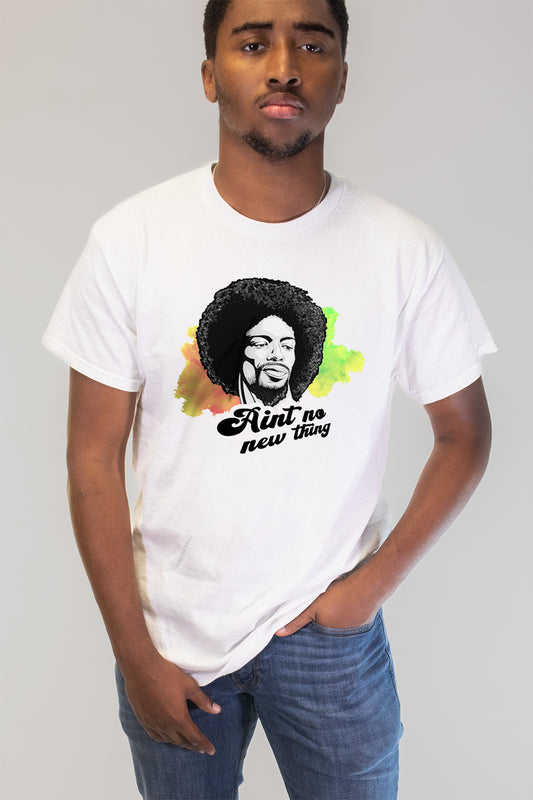
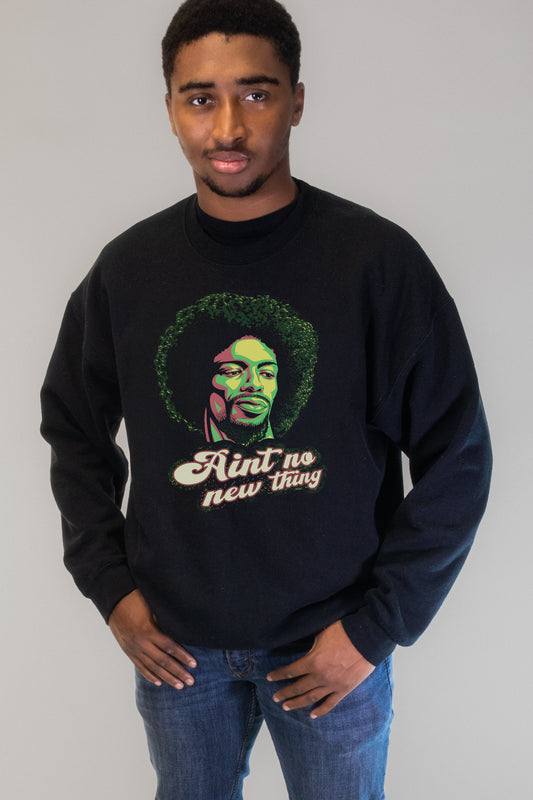
And that’s why the phrase still belongs on our chests, not as decoration, but as recognition.