
James Baldwin Wrote Like Somebody Was Counting on Him
Most of us meet James Baldwin after the sentence is already polished.
We meet the quote. The interview clip. The cigarette smoke. The steady stare. The voice that sounds like it has already walked through fire and come back with instructions.
We meet Baldwin as an icon.
By the time his words reach us, they feel inevitable. Like they were always there. Like the sentence arrived fully formed. Like the man who wrote it must have been born with some rare spiritual instrument the rest of us were not given.
That is what we often do to our giants. We make them untouchable. We flatten their choices into destiny. We call it a gift because “gift” is easier than reckoning with discipline. “Gift” lets us admire the finished thing without having to sit with the cost of its making.
But before Baldwin became a quote people passed around like scripture, there was another Baldwin.
There was a man awake at four in the morning in Saint-Paul-de-Vence, France, sitting at his typewriter while the village slept. There was the sound of keys clacking in the dark. There was the quiet room. There was the blank page. There was the pressure. There was the responsibility. There was the work.

And there was nobody else who could make him do it.
That may be the most human part of Baldwin’s greatness. Not that he was never afraid. Not that he was untouched by exhaustion. Not that he floated above the ordinary weight of family, money, expectation, loneliness, danger, and doubt.
It is that he had to face all of that and still return to the sentence.
Again and again and again.
James Baldwin wrote like somebody was counting on him because, in every direction, somebody was.
The Trouble With Calling It a Gift
People love to call brilliance a gift once they meet the finished version.
And clearly Baldwin was gifted. It would be silly to pretend otherwise. There was something extraordinary in the way he could look at a thing most people had learned to live around and name it so clearly that it suddenly became impossible to avoid. He had a way of making the private wound public without making it cheap. He could speak to the person inside the experience and the person outside of it without changing his voice to flatter either one.
That kind of clarity is rare.
But if we stop at “gifted,” we make the work sound effortless.
And nothing about Baldwin’s life suggests ease.
A gift does not sit you down at the desk. It does not protect your voice from the expectations of people who want you to become useful to them in a way that is no longer honest to you. It does not make the lonely decision. It does not revise the page. It does not choose truth when a smoother lie would sell better. It does not keep you from folding when fear gives you perfectly reasonable excuses.
Calling Baldwin gifted is not wrong.
It is just incomplete.
Because Baldwin had receipts for the thing people called a gift. He was there when it was being built. He knew the hours. He knew the fear. He knew what it meant to make sentences under pressure. He knew the difference between applause and truth. He knew that once people begin to recognize your voice, they also begin to develop opinions about how they want you to use it.
That is where the real struggle begins.
Because the moment people decide you have a gift, many of them begin to feel entitled to it.
They want more of it. They want their version of it. They want the part that comforts them. They want the fire, but only when it is aimed in a direction that does not burn too close to home. They want the familiar sound of your voice, even when the work is asking you to become someone new.
And if you are not careful, you can spend your life feeding people what they want and slowly starve the thing that made them come to you in the first place.
Baldwin’s discipline was not simply about writing often.
It was about protecting the work from becoming a performance of itself.

It was about refusing to give people what they wanted when he believed they needed something truer. It was about understanding that the voice people were counting on could not survive if it became obedient to expectation.
That kind of discipline is not glamorous. It does not always look like confidence. Sometimes it looks like isolation. Sometimes it looks like silence. Sometimes it looks like leaving the room, leaving the country, leaving the noise long enough to hear yourself think.
Sometimes the work has to go into the dark before it can survive the light.
Like a photograph negative, it has to develop away from the glare. Expose it too soon, and you do not reveal it. You ruin it.
Baldwin understood the darkroom.

Before the World Counted on Him
Before the world counted on James Baldwin to explain America, his family counted on him to help carry home.
That part matters.
Because we often talk about Baldwin as if he simply appeared in history already fully formed: the novelist, the essayist, the witness, the prophet, the man with the perfect sentence for every American contradiction. But Baldwin was also the oldest child in a large Harlem family. He was a son. A brother. A young man who understood responsibility before the world ever learned his name.
He was not raised in comfort. He was raised inside pressure. Money pressure. Religious pressure. Family pressure. Racial pressure. The pressure of being sensitive in a world that does not always know what to do with sensitive Black children. The pressure of being brilliant before brilliance has anywhere safe to go.
That kind of childhood can either shrink you or sharpen you.
Sometimes it does both before you learn the difference.
Baldwin grew up knowing what it meant to be needed. Not in the abstract. Not as a romantic idea. Needed in the practical sense. Needed because there were younger siblings watching. Because his mother needed help. Because the world outside the door was not built to be gentle.
So when we later see Baldwin carrying the moral weight of a nation in his essays and interviews, we should remember: he had been carrying weight long before the cameras came.

The public Baldwin did not come from nowhere.
The voice that could speak to a country’s conscience was formed in a life where responsibility was not optional.
And maybe that is part of why his writing still feels so alive. It does not sound like theory detached from consequence. It sounds like somebody who knew that words had to matter because life mattered. People mattered. Home mattered. The ones depending on you mattered.
He did not have the luxury of treating truth like decoration.
For Baldwin, writing was never only self-expression. It was provision. It was witness. It was survival. It was a way to rescue something honest from a world that kept trying to rename him, reduce him, endanger him, and make him smaller than he knew himself to be.
The Weight of Becoming Reliable
There is a particular kind of pressure that comes with becoming consistent.
At first, people are surprised by you. Then they are moved by you. Then they trust you. And once they trust you, they begin to count on you.
Why wouldn’t they?
If you keep showing up with clarity, people start bringing their confusion to you. If you keep telling the truth, people start looking for you when lies get loud. If you keep giving language to things others have only been able to feel, you become part of how they understand themselves.
That is beautiful.
It is also heavy.
Baldwin became one of those voices. Not because he was chasing that role, but because he kept proving himself solid enough to be trusted. He was not perfect. No human being is. But he was consistent in the deeper sense. He kept returning to the hard thing. He kept refusing the easy lie. He kept pressing language toward honesty even when honesty cost him comfort.
Over time, people did not just admire Baldwin.
They expected him.
They expected him to explain what was happening. They expected him to say what others were afraid to say. They expected him to carry pain into language without making it small. They expected him to be clear when the world was foggy. They expected him to be brave when bravery was dangerous.
And eventually, that expectation stretched beyond his own lifetime.

Generations who never heard him speak in real time still find him when the world becomes too much. We still go looking for Baldwin when America starts sounding like itself again. We still reach for him when we need somebody to tell us we are not imagining the violence, the absurdity, the spiritual exhaustion, the performance, the lie.
That is a strange kind of immortality.
To become so trustworthy that people born after you are gone still count on you to explain the room they are standing in.
But here is the tension: being needed can become a trap if you let other people’s expectations own the gift.
Baldwin had to give people the truth, not merely the version of truth they were prepared to applaud. He had to resist becoming a symbol while still understanding the importance of what he symbolized. He had to remain human while people were busy making him into something easier to display.
That may be one of the hardest parts of public greatness.
You have to serve without surrendering yourself.
You have to listen without becoming obedient.
You have to care without letting the need consume the source.
You have to remember that the work is for people, but it cannot be made by committee.
At the end of the day, no one else could make Baldwin write.
People could need it. People could praise it. People could criticize it. People could misunderstand it. People could wait for it.
But the room was still his.
The page was still his.
The discipline was still his.
The Darkroom of the Work
There is a reason the image of Baldwin at the typewriter in the early morning feels so powerful.

It strips away the performance.
No audience. No applause. No debate stage. No interviewer leaning forward. No room waiting for brilliance.
Just a man and the work.
That is where greatness becomes less mysterious and more demanding.
Because the truth is, most of what makes a person great happens before anyone has a reason to care. Before the finished essay. Before the book contract. Before the quote travels. Before the public decides that what you are doing matters.
There is always a darkroom.
A place where the work develops before it can withstand the light.
And the darkroom asks things of you that applause never will.
It asks whether you can keep going when nobody is impressed yet. It asks whether you can be honest when dishonesty would be easier. It asks whether you can resist the temptation to become a more marketable version of yourself. It asks whether you can sit with what you actually see, even when what you see makes your life more complicated.
That is where discipline becomes something deeper than routine.
Discipline is the bridge between having convictions and becoming someone history can count on.
Not success. Not visibility. Not popularity.
Greatness.
There is a difference.
Success can come from learning what people want and giving it to them efficiently. Greatness requires something more dangerous. Greatness asks you to stay loyal to what is true even when the reward is uncertain, delayed, or nowhere in sight.
Discipline is what makes you return to the desk after the applause and after the criticism.
Discipline is what makes you return after the check clears and after the check does not come.
Discipline is what makes you do the right thing when nobody is watching, and when everybody is watching. Because the person you become in private is eventually the person who has to stand in public.
That is the part we should take seriously when we look at Baldwin.
Not because every person is called to be James Baldwin.
But because every person who wants to live truthfully will eventually face a private version of the same question:
Will you fold?
Will you blend in?
Will you give people the version of yourself that causes the least friction?
Will you make peace with what is wrong because it is easier than insisting that what is wrong should change, not you?
That is where the superhero myth fails us.
Because when we turn Baldwin into a superhero, we make his courage seem unavailable. We act as if he possessed something beyond ordinary human reach. But what if part of his greatness was not that he escaped ordinary pressure, but that he refused to let ordinary pressure make him dishonest?
That is a choice.
A hard one. A repeated one. A costly one.
But still a choice.
And that means it has something to teach us.
What We Do With Baldwin Now
So what do we do with James Baldwin?
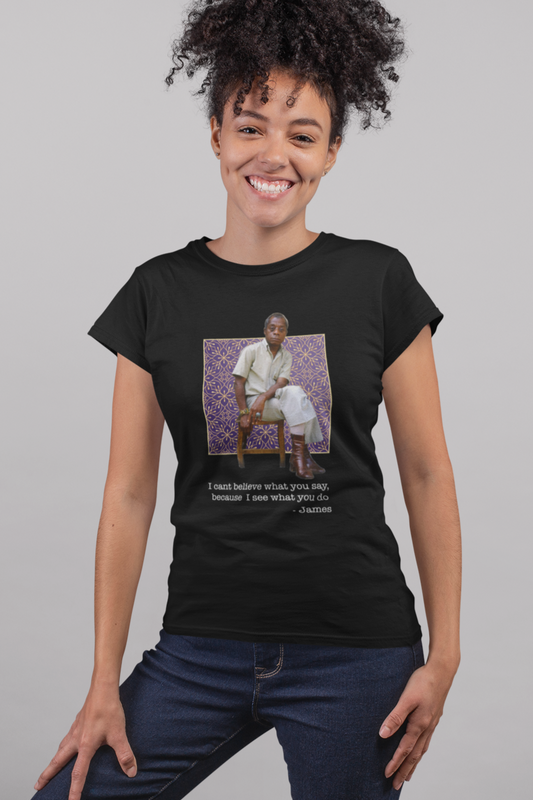
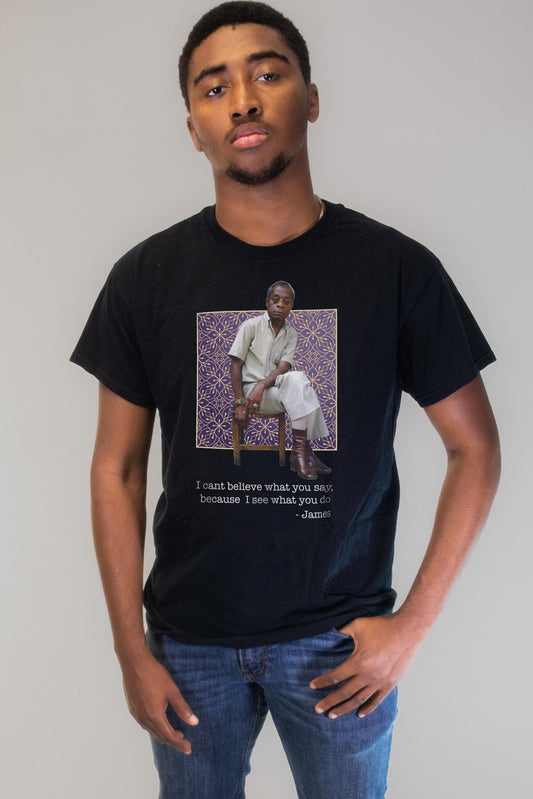
Not just the quote. Not just the clip. Not just the shirt. Not just the famous stare.
What do we do with the man?
Maybe we start by letting him be human.
Not smaller. More human.

Because making our icons human does not diminish them. It brings them closer. It reminds us that the people we now call giants had to deal with fear, pressure, family, money, expectation, danger, exhaustion, loneliness, and doubt. They had to live inside circumstances that were trying to shape them into something less honest than what they knew they were.
And the ones we still talk about are often the ones who did not fold.
That does not mean they were perfect.
It means they held fast long enough for the work to become real.
That matters for us now because we are living in a time with its own noise floor. So many people feel surrounded by things they cannot fix, systems they cannot move, conversations that flatten them, workplaces that drain them, algorithms that distract them, and public arguments that make it hard to hear themselves think.
It's easy to feel powerless. Which can make it feel easier to just, go along with the program.
It's easy to decide that the wrong thing is too big to challenge, so maybe the safest thing is to adjust yourself around it.
But Baldwin’s life keeps asking a harder question:
What if the wrong thing should change, not you?
What if your refusal to shrink is not arrogance?
What if the quiet work you are doing is not invisible, but unfinished?
What if the thing you are building needs the dark right now because it is not ready for the light yet?
That is not a call to romanticize struggle. Baldwin had enough struggle. So do we.
It's a call to stop confusing ease with purpose.
The work that matters will ask something of you. It will require discipline. It will require quiet. It will require refusing the easier version of yourself. It will require learning when to listen and when to leave the room. It will require becoming honest enough that people can count on you without owning you.
That is not superhero work.
That is human work.
But it is the kind of human work that can become legacy.
Somebody Was Counting
James Baldwin wrote like somebody was counting on him because, in every direction, somebody was.
His family counted on him before the world knew his name.
His readers counted on him when the world became too confusing to name.
The movement counted on him when witness required courage.
Future generations counted on him before they even knew they would need his words.
And somewhere under all of that, Baldwin had to count on himself.
He had to trust that the quiet mattered. He had to trust that the discipline mattered. He had to trust that the sentence was worth returning to. He had to trust that if he protected the work long enough, it could survive the light.
That is the Baldwin I want us to remember.

Where to Go Next
If this side of Baldwin speaks to you — not just the public fire, but the private pressure behind it — do not stop with the quotes. Spend time with the work itself. Baldwin is one of those writers who becomes clearer the more life you bring back to him.
Read:
The Fire Next Time
Start here if you want Baldwin at his most urgent, intimate, and accessible. The Fire Next Time is short, but it does not move lightly. It carries family, faith, race, memory, warning, and love in the same breath.
It is also one of the clearest examples of Baldwin writing like somebody was counting on him. He is not simply explaining America. He is speaking across generations, trying to tell the truth before the fire gets any closer.
No Name in the Street
Read this when you are ready for the weight behind the witness. No Name in the Street sits closer to grief, danger, disillusionment, and the emotional cost of surviving the Civil Rights era with your eyes open.
If The Fire Next Time feels like Baldwin sounding the alarm, No Name in the Street feels like Baldwin standing in the aftermath, still refusing to look away.
Watch:
James Baldwin in Conversation with Maya Angelou
For a more intimate look at the Baldwin behind the public fire, watch his conversation with Maya Angelou. He feels like a man talking to someone who knows him, loves him, and can ask the questions that reach beneath the polished answers.
What makes this conversation so powerful is how directly it touches the themes in this piece: family, survival, exile, responsibility, success, fear, and the burden of being needed. Baldwin talks about France not as a glamorous escape, but as “a kind of asylum” — the place where he could work. He speaks about missing his family, carrying them with him, and needing distance from America in order to keep writing about it honestly.
There is also a beautiful tension in the way Angelou draws out his humanity. You hear Baldwin reflect on success, not as arrival, but as danger. You hear him talk about writing after assassinations, after grief, after wondering whether the typewriter could save anybody at all. And you hear how his family, especially his brother David, helped him keep faith with the work when the weight of it became almost too much.
Watch this one when you want to meet Baldwin not only as the icon, but as the brother, the son, the friend, the writer, and the man still trying to use the time.
James Baldwin and Nikki Giovanni: A Conversation
This is always a must watch and truly a moment in history that I'm so glad was captured. If you haven't already seen it, watch it. You'll thank me later.